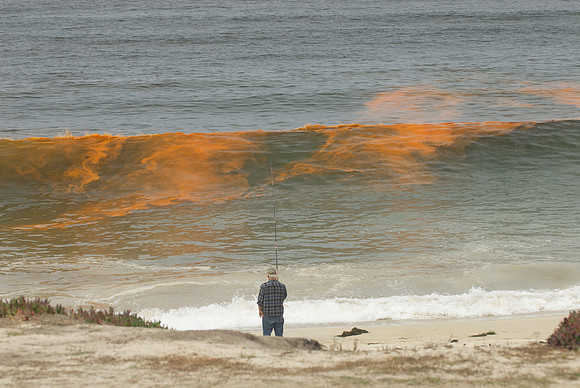
The red algae was all along the bluff trail in HMB this week. Not really much of a photograph, but the phenomonen was quite interesting. Not entirely sure I would be fishing like this fellow...
* * * * *
Red tide is a common name for a phenomenon more correctly known as an algal bloom (large concentrations of microorganisms), an event in which estuarine, marine, or fresh water algae accumulate rapidly in the water column and results in discoloration of the surface water. It is usually found in coastal areas.[1]
These algae, more specifically phytoplankton, are single-celled protists, plant-like organisms that can form dense, visible patches near the water's surface. Certain species of phytoplankton, such as Dinoflagelate, contain photosynthetic pigments that vary in colour from green to brown to red.
When the algae are present in high concentrations, the water appears to be discoloured or murky, varying in colour from purple to almost pink, normally being red or green. Not all algal blooms are dense enough to cause water discolouration, and not all discoloured waters associated with algal blooms are red. Additionally, red tides are not typically associated with tidal movement of water, hence the preference among scientists to use the term algal bloom.
Some red tides are associated with the production of natural toxins, depletion of dissolved oxygen or other harmful effects, and are generally described as harmful algal blooms. The most conspicuous effects of red tides are the associated wildlife mortalities among marine and coastal species of fish, birds, marine mammals and other organisms. In the case of Florida red tides, these mortalities are caused by exposure to a potent neurotoxin called brevetoxin which is produced naturally by the marine algae Karenia brevis.
"Red tide" is a colloquial term used to refer to a natural phenomenon known as a "harmful algal bloom" or "HAB". The term "red tide" is being phased out among researchers for the following reasons:
1. Red tides are not necessarily red and many have no discolouration at all.
2. They are unrelated to movements of the tides.
3. A wide variety of algal species are known as bloom-formers.
It is being replaced in favour of the more accurate "harmful algal bloom" for harmful species, or simply "algal bloom" for non-harmful species.
en.wikipedia.org/wiki/Red_tide